Note
Go to the end to download the full example code.
Band structure and DOS from Phonopy input
Run DispersionWorkChain and
DosWorkChain on NaCl Phonopy output
(phonopy_nofc_noborn.yaml + force_constants.hdf5 + BORN_nacl). The
files are passed straight to each workflow as its phonopy force-constants
source; nothing reads them in a separate step first. The last section shows how
AiiDA caching lets the second workflow reuse the first one’s read.
Set up AiiDA
from _aiida_setup import example_data, get_python_code, show_provenance
from aiida import orm
from aiida.engine import run_get_node

code = get_python_code()
Load the workflows
The three Phonopy files are the phonopy source of each workflow. Each reads
them inside its ForceConstantsWorkChain sub-workflow.
from aiida.plugins import WorkflowFactory

# Load via WorkflowFactory (direct imports like
# `from aiida_alc_ins.workflows import ...` also work)
DispersionWorkChain = WorkflowFactory("alc_ins.dispersion")
DosWorkChain = WorkflowFactory("alc_ins.dos")

phonopy_files = {
    "summary": orm.SinglefileData(
        example_data("phonopy", "NaCl_hdf5", "phonopy_nofc_noborn.yaml")
    ),
    "force_constants": orm.SinglefileData(
        example_data("phonopy", "NaCl_hdf5", "force_constants.hdf5")
    ),
    "born": orm.SinglefileData(example_data("phonopy", "NaCl_hdf5", "BORN_nacl")),
}
Enable caching
Caching is switched on for the Phonopy read so that the second workflow below can reuse the first one’s result. It is an optional detail, explained at the end.
from aiida.manage.configuration import get_config

READ_PHONOPY_PROCESS_TYPE = (
    "aiida_alc_ins.workflows.force_constants.read_phonopy_force_constants"
)
get_config().set_option("caching.enabled_for", [READ_PHONOPY_PROCESS_TYPE])
['aiida_alc_ins.workflows.force_constants.read_phonopy_force_constants']
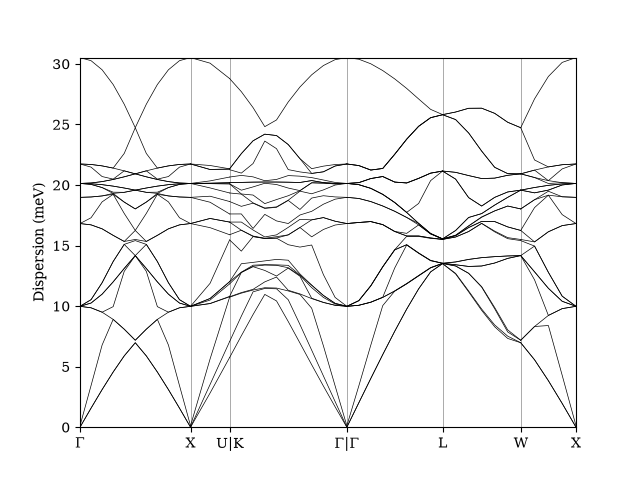
Band structure
bands_results, bands_node = run_get_node(
    DispersionWorkChain,
    force_constants={"phonopy": phonopy_files},
    q_spacing=orm.Float(0.1),
    code=code,
)
bands_results["band_structure"].show_mpl()
Force constants not found in /tmp/tmp3jkl6lxn/phonopy_nofc_noborn.yaml, attempting to read from /tmp/tmpg9rc8f0m/force_constants.hdf5
Born, dielectric not found in /tmp/tmp3jkl6lxn/phonopy_nofc_noborn.yaml, attempting to read from /tmp/tmpos_pyxvp/BORN_nacl
Written to /tmp/tmpfcsiiu_7/euphonic_object.json
/home/runner/work/aiida-alc-ins/aiida-alc-ins/.venv/lib/python3.12/site-packages/seekpath/getpaths.py:427: SupercellWarning: The provided cell is a supercell: the returned k-path is the standard k-path of the associated primitive cell in the basis of the supercell reciprocal lattice.
  warnings.warn(
Written to /tmp/tmp7392csx6/euphonic_object.json
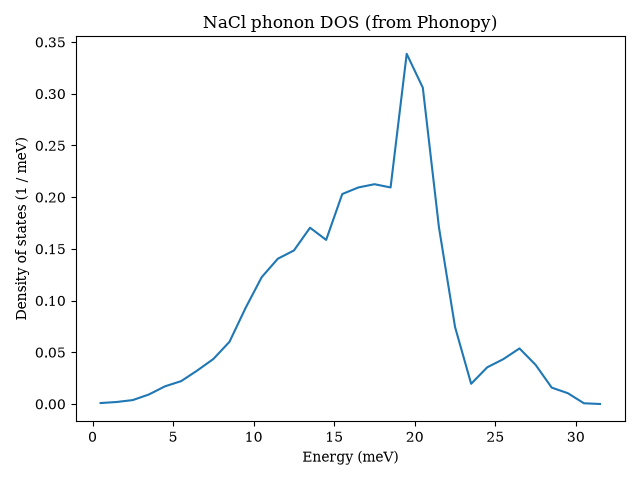
Density of states
The DOS workflow is given the same files.
dos_results, dos_node = run_get_node(
    DosWorkChain,
    force_constants={"phonopy": phonopy_files},
    q_spacing=orm.Float(0.2),
    energy_spacing=orm.Float(1.0),
    code=code,
)

import matplotlib.pyplot as plt

dos = dos_results["dos"]
_, energy, energy_unit = dos.get_x()
((_, density, dos_unit),) = dos.get_y()

fig, ax = plt.subplots()
ax.plot(energy, density)
ax.set_xlabel(f"Energy ({energy_unit})")
ax.set_ylabel(f"Density of states ({dos_unit})")
ax.set_title("NaCl phonon DOS (from Phonopy)")
fig.tight_layout()
Provenance
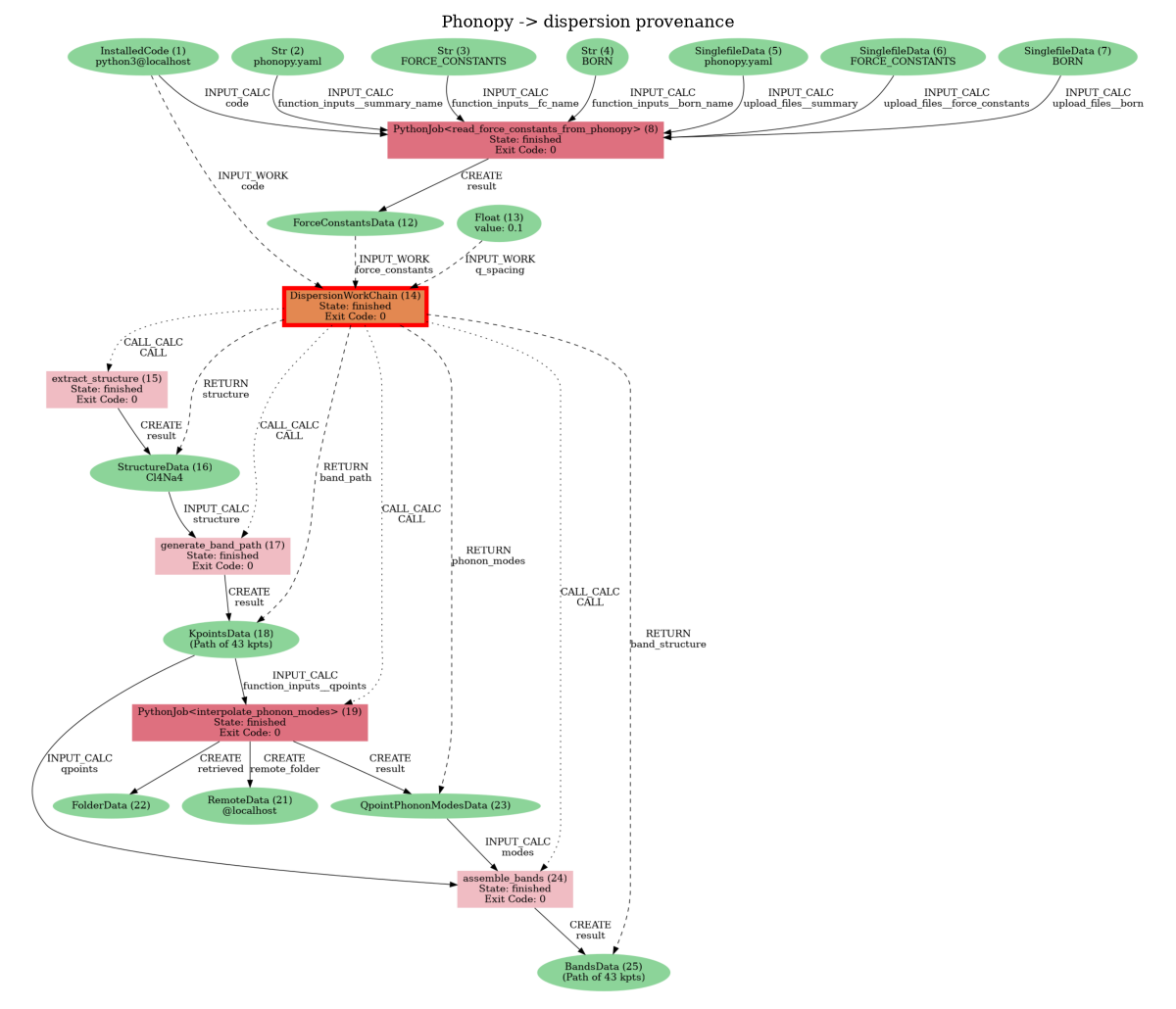
The graph traces the band structure back through the dispersion workflow and its
ForceConstantsWorkChain to the read_phonopy_force_constants calculation,
which links the three Phonopy files – the full history in one picture.
show_provenance(bands_node, title="Phonopy -> dispersion provenance")
<Figure size 1200x1299.34 with 1 Axes>
Avoiding the repeated read
Both workflows were given the same Phonopy files, and each records its own
read_phonopy_force_constants calculation. Because caching was enabled at the
start, the DOS run did not read the files again: AiiDA recognised the same file
contents and reused the result of the first read.
So to run several workflows on one Phonopy file set, pass the same files each time. Caching is off by default in AiiDA; the AiiDA caching documentation explains how to enable it permanently for a profile.
The DOS run’s read is marked as created from the cache. Asserting this means a silent loss of cacheability fails the documentation build instead of passing unnoticed.
dos_reads = [
    process
    for process in dos_node.called_descendants
    if process.process_label == "read_phonopy_force_constants"
]
reused = all(read.base.caching.is_created_from_cache for read in dos_reads)
print(f"Phonopy read taken from the cache: {reused}")
assert dos_reads
assert reused, "expected the DOS run to reuse the cached Phonopy read"
Phonopy read taken from the cache: True
Alternative: reuse the force-constants node directly
The force constants can also be taken from the first run and passed to another
workflow as its node source, which needs no caching. DispersionWorkChain
does not output them, so they are found as the output of its
ForceConstantsWorkChain child. This suits a node you want to hold on to
explicitly, such as one built by other means.
fc_child = next(
    child
    for child in bands_node.called
    if child.process_label == "ForceConstantsWorkChain"
)
force_constants_node = fc_child.outputs.force_constants

# The node would be passed as
# ``DosWorkChain, force_constants={"node": force_constants_node}``.
print(f"Force constants node: {force_constants_node.uuid}")
Force constants node: f074fd9b-d185-40f6-b543-0915bdcbe6a1
Total running time of the script: (0 minutes 7.972 seconds)